Mediul ambiant

Soil and Sediments

Soil and Sediments

...

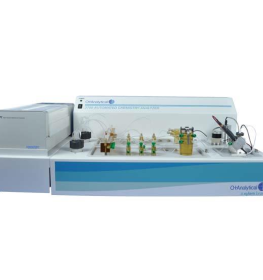
Automated Chemistry Analyzer FS3700

Improve laboratory workflow with the FS3700 by running multiple flow methods (including SFA, FIA, iSFA, and SFIA) on different channels simultaneously. Ideal for the analysis of ammonia, chloride, cyanide, fluoride, nitrate, phenol, phosphorous, silica, TKN, and more! FS3700 Features: Intuitive software - FlowView™ Software streamlines operation Fast results - Performs 30-90 analyses per hour, per channel Versatile – Uses interchangeable, pre-assembled chemistry cartridges Flexible – Tailors methodology with two plug-in detector modules Accurate – Expanded Range™ photometric detector and autoscaling software eliminate off-scale samples Analysis Module 1 or 2 chemical analysis channels per chassis Analysis Module Dimensions 31 in. W x 17.5 in. D x 10.5 in. H 78.74 cm W x 44.45 cm D x 26.67 cm H FS 3700 Dimensions with 90-position Autosampler Approximately 44 in. (112 cm) W FS 3700 Dimensions with 360-position Autosampler Approximately 51.5 in. (131 cm) W Injection Valve 8 or 10-port switching valve with chemically-inert wetted surfaces Photometric Detector 420-880 nm, with PEEK path lengths of 5-, 10- or 20-mm Amperometric Detector Silver working electrode silver/silver chloride reference stainless steel counter electrode In-line Heater Included as needed, mounted underneath chemistry cartridge user programmable in 1 ̊C increments UV-digestion Module Included as needed, mounted underneath chemistry cartridge Peristaltic Pump 24-channel, fits on top of analysis module Autosampler 90-position, X-Y-Z (90 samples + 9 standards) 360-position, X-Y-Z (360 samples + 10 standards) Tubing FEP Teflon® and EVA ethylene-vinyl acetate copolymer Manifolds / Fittings Polysulfone Analysis Methods / Documentation Validated chemistries for specific analytes / sample matrices with performance data Operating Software FlowView Operating System Windows® 7, Windows® 8, 8.1 and 10 Data Collection 6 channels per instance of software Multiple instances of software can be run on a single computer PC to FS 3700 Communications USB Power Supply 24VDC universal switching power supply for operation with 90-250VAC 50/60Hz source Power Requirements 110VAC/60 Hz or 230VAC/50 Hz Weight (Analysis Module) 19.5 kg (43 lbs.), typical for analysis module and pump, two injection valves, chemistry cartridges, detector modules Certifications CE Safety EN 61010-1 EMC Immunity & Emissions EN 61326-1:2006 Methods:  Ammonia Nitrogen by USEPA 350.1 Ammonia/TKN by SFA and Gas Diffusion ASTM D7237 Available Cyanide by ASTM D6888 Chloride by Standard Methods Free Cyanide by ISO 14403 Hexavalent Chromium Low-Level Phosphorus (All Forms) by USEPA 365.1 MBAS by ISO 16265 Nitrate Nitrite in Water using FIA & SFA Nitrate and Nitrite in Milk OIA-1677 Available Cyanide by Ligand Exchange Post-Distillation Cyanide by USEPA 335.4 Post-distillation Phenol by USEPA-420.4 Sulfate by USEPA 375.2  
...

8890 GC System

The browser interface provides remote connectivity enables you to monitor your GC system, check system logs, and perform diagnostics tests, from inside, as well as outside, the laboratory. The full-function touch screen gives a visual report of the system configuration letting you update methods and sequences, perform maintenance routines, and check instrument status. Built-in intelligence autonomously monitors the health of the system, alerts the user of potential issues before they affect chromatographic performance, and offers helpful step-by-step guides to resolve issues. Unique 6th-generation microchannel-based EPC architecture provides a significant improvement in reliability and longevity against gas contaminants such as particulates, water, and oils, extending the life of the instrument consumables. Capillary Flow Technology (CFT) provides unique gas flow connections for multidimension gas chromatography (GC x GC/Deans Switch), comprehensive two-dimension gas chromatography (GC x GC) with flow modulation, and backflush at the beginning, middle, or end of an analytical column that are oven mountable and very low thermal mass. Single filament TCD that doesn’t require a separate reference gas, or manual potentiometer adjustment, yet provides a stable baseline with a minimal amount of signal drift commonly seen with valve switching. Autoranging FID provides the ability to detect and quantitate from percent levels to parts per billion (ppb) in a single injection. Sulfur or nitrogen chemiluminescence detector provides low ppb detection, equimolar response, and quantitation for sulfur or nitrogen contaminants without quenching from matrix. Cost-saving advanced electronic pneumatic controllers such as Helium Conservation Module, Hydrogen Sensors, and Alternate Carrier Gas Solutions, dramatically reduce the amount of helium used offering both flexibility and higher levels of safety in your laboratory.
...

8860 GC

Features: Advanced instrument intelligence functionality for GC diagnostics and maintenance helps lab managers better avoid unplanned downtime, minimizing costly operational surprises Color touch screen display provides access to GC setpoint and status information, configuration, and signal plot to confirm that analyses are progressing as intended Browser user interface provides convenient access from a PC or tablet to edit methods and sequences, access advanced intelligence functions, see instrument status, and run diagnostics from any place within reach of your lab network—even from home Unique 6th-generation microchannel-based EPC architecture provides a significant improvement in reliability and longevity against gas contaminants such as particulates, water, and oils over previous generation Agilent GC designs, as well as other GC vendors’ designs Full 8860 electronic pneumatics control (EPC)—available on all inlets and detectors—ensures better repeatability of retention times and peak areas, more consistent results, and less rework Optional helium conservation module reduces the amount of helium used and the associated costs Optional Hydrogen Sensor Module Series 2 detects hydrogen leaks early and shuts off gas flows, continuously monitors status using built-in intelligent diagnostics, and requires calibration only every six months Retention time locking (RTL), available with most Agilent OpenLab CDS software, provides the ability to precisely match chromatographic retention times in any GC system to those in another Agilent GC system with the same method and column Autoranging flame ionization detector (FID) provides a wide dynamic response range, enhances accuracy, and minimizes preparation requirements for samples that contain very high or very low compound concentrations Single-filament thermal conductivity detector (TCD) provides a stable baseline without drift and does not require a separate reference gas or manual potentiometer adjustment
...

6495D Triple Quadrupole LC/MS

Features: NEW: Edwards nXL200i enhanced oil free dry pump option, delivering over 50% savings in energy consumption and heat dissipation Fourth generation, innovative iFunnel technology captures more of the ESI plume during ionization, resulting in dramatic improvement of signal response and detection limit compared to non-iFunnel systems SWARM autotune obtains the absolute best system settings using a multifactorial optimization artificial intelligence algorithm Intelligent reflex workflows provide data-dependent sample reinjection protocols that focus on sample assurance or improvements in sample throughput VacShield enables quick and easy cleanup of matrix deposits without venting the system Scheduled tuning alleviates the burden of routine maintenance, so you know that the mass spectrometer is always at peak performance Early maintenance feedback provides an easy-to-read dashboard to help visualize LC/MS instrument health and anticipate upcoming maintenance events Application-focused tuning and workflows facilitate analysis and quantitation of lipids, metabolites, peptides, proteins (digested), PFAS, and pesticides Compound optimizer allows fast method development by enabling users to create methods or add new compounds to an existing method, with automatic tuning to develop an optimal MRM transition for each new compound Seamless method transfer between Agilent LC/MS instruments on MassHunter 12 or higher shortens method development time and eases the burden of moving methods from system to system